
Reviewed · ARTISAN AND CRAFT WORKSHOPS
Arabic Calligraphy Workshop Marrakech
Small tools, beautiful results. This two-hour workshop gives you a hands-on introduction to Arabic calligraphy in a central setting, with practice in letters, pen control, composition, and traditional styles. I like the personal attention promised by a group capped at 10, and I like that you leave with your name calligraphed and bookmarks bearing words you choose.
The main consideration is price. At $63.88 per person, this is not the cheapest short activity in Marrakech, especially if you are mainly looking for a souvenir. You are paying for instruction, materials, a cultural lesson, and time with an artist, so the value depends on how much you want to learn rather than simply watch.
In This Review
- Key points at a glance
- Meeting at Marrakech Museum near Place Ben Youssef
- Beginning with the story behind Arabic calligraphy
- Handling the pen, ink, and bamboo qalam
- Learning letters and their sounds
- Exploring styles and putting letters together
- The practical session takes center stage
- Leaving with a name and chosen expressions
- Is $63.88 a fair price?
- Who will enjoy this Marrakech activity?
- Cancellation and timing advice
- Should you book the Arabic Calligraphy Workshop Marrakech?
- FAQ
- How long does the Arabic calligraphy workshop last?
- What time does the workshop start?
- Where does the workshop begin?
- Where does the activity end?
- How much does the workshop cost?
- What will I learn during the workshop?
- What do I take home?
- Can I cancel for a refund?
Key points at a glance
- Practice with a bamboo qalam: You learn how the traditional pen is held and used, including the basic strokes behind Arabic letters.
- Personalized keepsakes: Your name is calligraphed for you, and you choose expressions for bookmarks such as happiness, love, wisdom, or life is beautiful.
- Small group setting: The maximum group size is 10, which should make it easier to ask questions and get help with technique.
- A central Marrakech meeting point: The workshop begins at Marrakech Museum near Place Ben Youssef at 3:00 pm and ends there.
- A friendly, family-suitable activity: The class is described as suitable for adults and children, and the atmosphere includes Moroccan mint tea and pastries.
- Flexible booking terms: You receive confirmation when booking, and cancellation is free up to 24 hours before the start time.
Meeting at Marrakech Museum near Place Ben Youssef
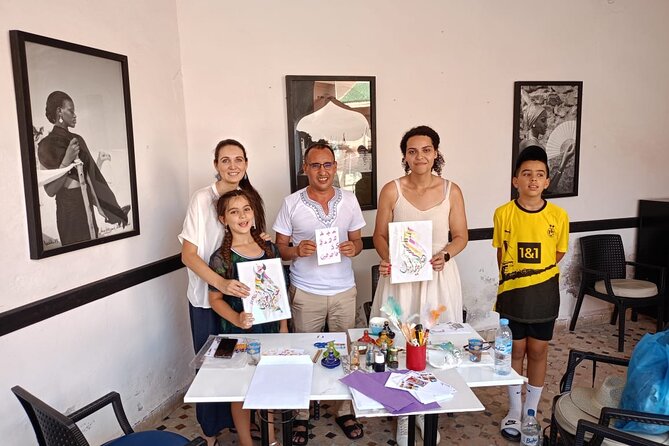
The class begins at 3:00 pm at Marrakech Museum, Place Ben Youssef, in central Marrakech. This location matters because it places the workshop near one of the medina’s main cultural areas, rather than sending you out to a distant studio or hotel district.
You should allow time to find the museum entrance and arrive ready to start. The information gives the meeting point as Marrakech Museum, not a hotel pickup location, so you need to make your own way there. The workshop ends at the same place.
That arrangement works well if you are already exploring the medina. You can pair the class with the Ben Youssef area, then continue with dinner or an evening walk afterward. It is less convenient if you are staying far from the old city and hoping for transportation to be included.
The start time is also useful. A 3:00 pm class fits neatly into a Marrakech day, especially if you prefer to spend the hotter part of the afternoon indoors. The activity lasts about two hours, so you should finish near 5:00 pm, though the exact end time may depend on the pace of the group.
More Artisan and Craft Workshops in Marrakech
- Marrakech: Traditional MRC Hammam and Massage with Argan Oil
★ 4.0 · 1,202 reviews - Marrakech: Pottery Workshop with Moroccan Tea
★ 4.8 · 756 reviews - Marrakech: Traditional Moroccan Hammam, Massage & Argan Oil
★ 4.3 · 294 reviews
Beginning with the story behind Arabic calligraphy
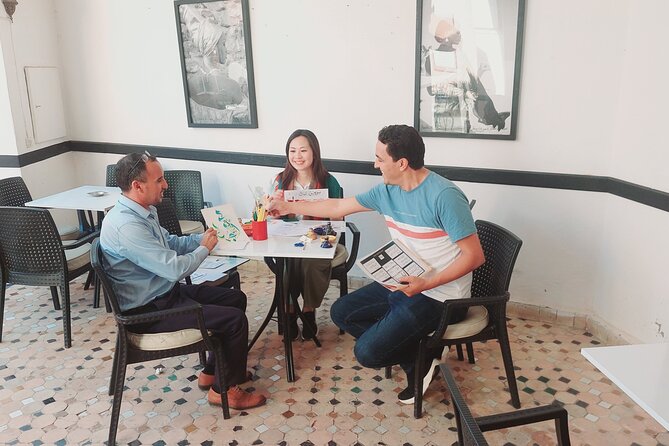
The workshop starts with an introduction to the history and meaning of Arabic calligraphy. This is important because the class is not only about copying shapes. Arabic calligraphy has a close connection to language, proportion, decoration, and written expression.
You receive an explanation of the Arabic alphabet, or abjad, and how the letters sound. One particularly useful point is pen position. Even people who have studied Arabic for years may not have learned how to hold the qalam correctly, so this early instruction can change the way you approach the script.
I would pay close attention during this part. The opening explanation gives you a better sense of why the letters look the way they do, why certain strokes are thick or thin, and how separate letters relate to one another.
The exact amount of history depends on the instructor and the group. The activity description calls it a brief introduction, so you should not expect a full academic lecture on Arabic writing. Instead, think of it as a practical foundation for the work that follows.
Handling the pen, ink, and bamboo qalam
Next comes an introduction to the tools. You learn about the pen and ink used for Arabic calligraphy, with special attention to the bamboo qalam. The qalam is more than a writing instrument. Its cut and angle affect the width, shape, and rhythm of every mark.
This is where the workshop becomes useful for beginners. A normal ballpoint pen lets you write in almost any direction with little change in line width. A calligraphy pen demands more control. The angle of the nib, pressure on the page, and direction of the stroke all matter.
You begin with basic forms such as circles, straight lines, and curves. These exercises may look simple, but they train the movements needed for letters. I like this order because it avoids throwing you straight into a complicated word before you understand the basic marks.
The class is practical, so expect to spend much of the session writing rather than listening. That is good news if you learn by doing. It also means you should not worry if your first attempts look uneven. The point is to understand the movement and gain control, not produce a finished masterpiece immediately.
Learning letters and their sounds
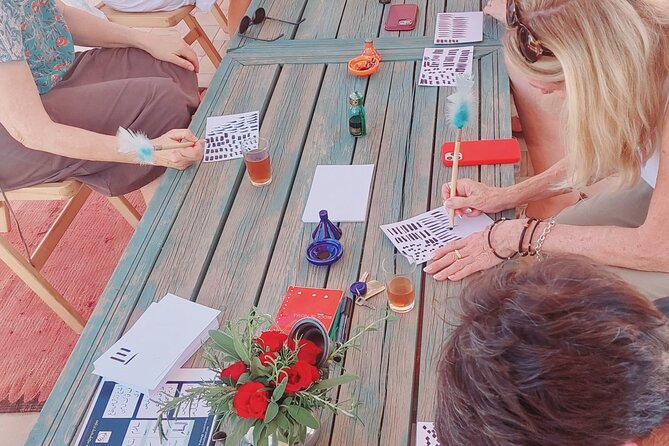
Once you have tried the basic marks, the instructor shows you how to form Arabic letters. You also learn their sounds, giving the lesson value for anyone interested in the Arabic language as well as the art.
Arabic letters can change shape depending on where they appear in a word. Even if the workshop only introduces the foundations, this helps explain why Arabic writing looks fluid and connected. You are not simply learning a set of isolated symbols.
The teacher’s role makes a big difference here. The instructors associated with this class include Zizi, Houcine, Hussein, Essaid, and Said, though the person leading your session may vary. The strongest feedback describes the teaching as patient, kind, encouraging, and clear.
That matters more than a polished room or a long lecture. Calligraphy can feel intimidating when your lines go wrong. A calm instructor who corrects your grip and stroke without rushing you turns the class into a pleasant lesson instead of a test.
Families can also consider this stage carefully. The workshop is described as suitable for adults and children, but younger children may need help with the pen and patience with repeated exercises. The small maximum group size should help, though individual attention can vary if all 10 places are filled.
More Artisan and Craft Workshops:
- Marrakech: Traditional Moroccan Hammam with Argan Black Soap
★ 3.8 · 120 reviews - Marrakech: Traditional MRC Hammam and Massage with Argan Oil
★ 3.9 · 91 reviews - Lamsaty Pottery Workshop with Moroccan Tea
★ 5.0 · 75 reviews - Marrakech Medina Basket Embroidery Workshop
★ 4.9 · 69 reviews
Exploring styles and putting letters together
The class then moves from individual letters toward composition and different styles of Arabic calligraphy. This is where you begin to see how a few marks can become a balanced design.
Composition is not only about writing a word correctly. You also consider spacing, scale, alignment, and the shape of the overall piece. Arabic calligraphy can be arranged in many ways, and the instructor introduces some of those approaches in a practical format.
Do not expect to master several complete styles in two hours. The workshop gives you an introduction, not professional training. Still, comparing styles helps you understand why Arabic calligraphy can look formal, decorative, compact, or flowing depending on the method.
I find this part especially worthwhile for visitors who have admired Arabic signs and artwork in Morocco but never understood how they were made. After practicing the strokes yourself, you look at written decoration with a more informed eye.
The session also gives you a chance to ask questions. If you have a particular name or phrase in mind, mention it during the class. The activity includes personalized calligraphy, and knowing your desired wording early may help the instructor plan the finished pieces.
The practical session takes center stage
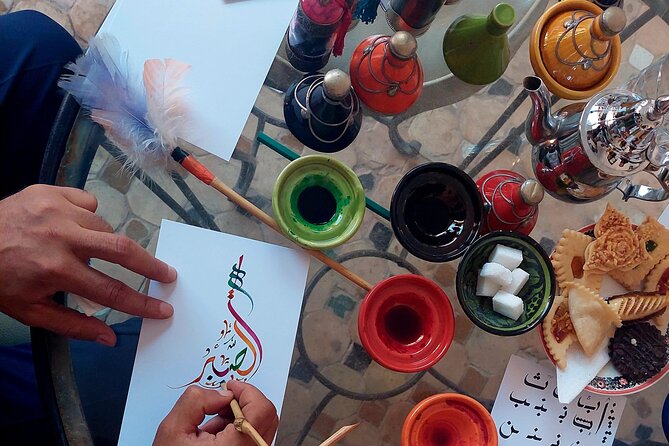
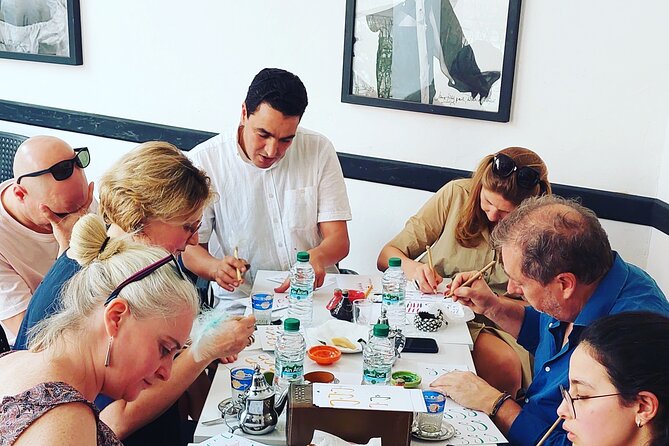
Practice dominates the workshop. You work with the pen, ink, letters, and forms introduced earlier, receiving guidance as you go.
This hands-on format is the strongest reason to choose the experience. A demonstration can show you what Arabic calligraphy looks like, but using the qalam yourself teaches you why the art takes control and patience. You feel the difference between a straight stroke and a curved one. You also learn quickly that a small change in angle can alter the mark.
The activity suits people who want an active cultural experience. If you prefer to sit back and watch an artist create a finished piece, you may find the class more demanding than expected. The emphasis is on your own practice.
The workshop appears to maintain a warm, informal tone. Mint tea and Moroccan pastries are part of the setting described for the class, adding a local touch without taking over the lesson. Tea is welcome, but the real attraction remains the instruction.
You may find the results charming rather than perfect. That is part of the appeal. Your writing records the experience in a way a shop-bought souvenir cannot, even if your early letters wobble a little.
Leaving with a name and chosen expressions
A personal name is calligraphed for each participant by the workshop master. This is separate from your own practice and gives you a polished example of the art.
You also leave with bookmarks carrying expressions of your choice. Suggested words and phrases include happiness, life is beautiful, live your life, wisdom, fidelity, love, and dream. You may choose from these or request another expression, as long as the instructor can accommodate it.
These small items add real value to the session. You are not only paying for two hours of activity. You receive a personal memento connected to the lesson, and the bookmarks are practical enough to use after your visit.
There is also a nice contrast between the two kinds of keepsake. The artist’s calligraphy shows what trained technique can produce. Your own practice shows where you began. Together, they make the experience easier to remember than a standard souvenir from a market stall.
If the name or phrase is important to you, check the spelling before the calligraphy is completed. Arabic transliteration can vary, particularly for names that do not have a direct Arabic equivalent. The supplied information does not promise a formal translation service, so it is sensible to clarify your preferred version with the instructor.
Is $63.88 a fair price?
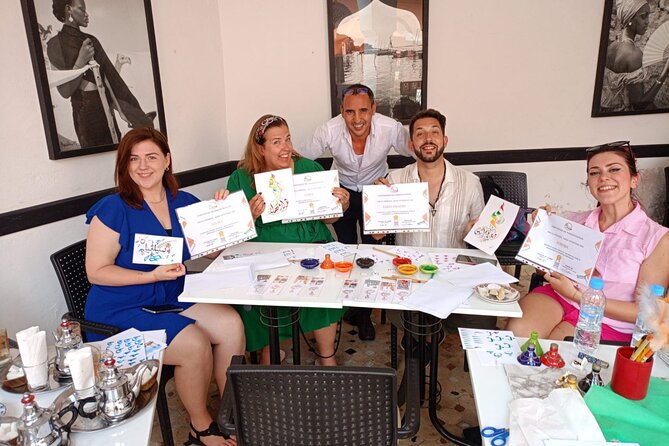
At $63.88 per person, the workshop sits in the midrange for a short cultural activity. The price makes the most sense if you value direct instruction and a personal result.
You receive about two hours of teaching, practice with calligraphy tools, an introduction to Arabic letters and sounds, help with composition, and personalized calligraphy. The small group limit of 10 also gives the class a better chance of feeling like a lesson instead of a demonstration.
The price is harder to justify if you mainly want the finished name card or bookmarks. Similar souvenirs may cost less in Marrakech, but they will not include the explanation of how the script works or the chance to use a qalam yourself.
I would consider this good value for an art-minded visitor, a language student, or a family seeking a structured activity. It is less compelling for someone with only a short time in the city who wants to see as many sights as possible.
The workshop is booked an average of 38 days ahead, which suggests that planning early is wise, particularly if you want the 3:00 pm time on a specific date. Confirmation is provided at booking, and the mobile ticket makes it easy to keep the reservation on your phone.
Who will enjoy this Marrakech activity?
I would recommend the class to you if you enjoy learning a local craft rather than simply collecting photographs. You do not need to be an artist. The session begins with basic lines, curves, circles, and letter forms, so beginners have a clear entry point.
Arabic language students should find it useful because the class connects letter shapes with sounds. One participant with years of Arabic study still found the pen grip instruction valuable, which shows that the lesson can help beyond absolute beginners.
Families may also enjoy it. The activity is described as suitable for adults and children, and the creative format gives younger participants something active to do. Keep in mind that calligraphy requires careful hand movements, so children who dislike slow practice may lose interest.
The workshop is also a good match for couples. A small class, mint tea, and personalized keepsakes create a shared experience with more meaning than a quick shopping stop.
You may want to skip it if you dislike sitting and repeating basic exercises, or if your main goal is a fast sightseeing stop. Two hours is a substantial block of time in Marrakech, and the value depends on your interest in the process.
The activity is near public transportation, and service animals are allowed. Most people can participate, but the available details do not provide more specific accessibility information. If you have mobility or seating needs, confirm those arrangements before booking.
Cancellation and timing advice
You can cancel for a full refund up to 24 hours before the local start time. Changes made less than 24 hours before the class are not accepted, and cancellations inside that window are not refunded.
I would book once your afternoon plans are settled. The class begins at 3:00 pm, and arriving late could mean missing the introduction to the tools or the first letter exercises. Since the meeting point is fixed at Marrakech Museum, leave enough time to reach Place Ben Youssef through the medina.
The class ends back at the meeting point. That makes it easy to continue exploring central Marrakech, find dinner nearby, or return to your accommodation, depending on where you are staying.
Should you book the Arabic Calligraphy Workshop Marrakech?
Book this workshop if you want to learn a small but meaningful Moroccan art form and take home something personal. The strongest features are the hands-on qalam practice, the friendly teaching style associated with instructors such as Zizi and Essaid, and the finished name calligraphy and bookmarks.
I would be more cautious if $63.88 feels high for a two-hour class or if you want only a decorative souvenir. In that case, shopping may be cheaper. But if you value instruction, cultural context, and the chance to make your own marks, this is a worthwhile afternoon near Place Ben Youssef.
FAQ
How long does the Arabic calligraphy workshop last?
The workshop lasts approximately two hours.
What time does the workshop start?
The scheduled start time is 3:00 pm.
Where does the workshop begin?
It begins at Marrakech Museum, Place Ben Youssef, Marrakech 40000, Morocco.
Where does the activity end?
The activity ends back at the meeting point at Marrakech Museum.
How much does the workshop cost?
The listed price is $63.88 per person.
What will I learn during the workshop?
You will receive an introduction to Arabic calligraphy, learn about pens and ink, practice basic shapes, form Arabic letters, explore composition and styles, and spend time practicing.
What do I take home?
Your name will be calligraphed by the workshop master. You can also leave with bookmarks bearing expressions you choose, such as happiness, wisdom, love, or dream.
Can I cancel for a refund?
Yes. You can cancel at least 24 hours before the local start time for a full refund. Cancellations or changes made less than 24 hours before the start are not accepted for a refund.
More Workshops
- Marrakech: Moroccan Cooking Class with Pickup
★ 4.6 · 1,862 reviews - Marrakech: Traditional Moroccan Cooking Class & Market Visit
★ 4.8 · 1,861 reviews - Marrakesh: Moroccan Dishes Cooking Class with a Local Chef
★ 5.0 · 1,615 reviews - Moroccan Cooking Class & Marrakech Market Visit with Chef Khmisa
★ 5.0 · 1,504 reviews
Just added around Marrakech
- One Way – Marrakech Airport Private Taxi Transfers★ 4.5 · 17 reviews
- Majorelle Garden, YSL & Berber Museum: Exciting Round-Trip Tour★ 4.5 · 17 reviews
- Marrakech: Agafay Desert Buggy Tour with Transfer★ 4.4 · 17 reviews
- Ourika valley day trip★ 5.0 · 17 reviews
- From Marrakech: small group Day Trip To Essaouira Mogador★ 4.9 · 17 reviews
- Essaouira Day Trip from Marrakech★ 5.0 · 17 reviews
- From Marrakech: Ouzoud Waterfalls Full-Day Guided Tour★ 4.2 · 17 reviews
- Best Marrakech to Merzouga 3 D 2N Sahara Desert Tour Adventure★ 5.0 · 17 reviews
Artisan and Craft Workshops, compared.
Traditional MRC Hammam and Massage with Argan Oil
Read our review →
Traditional Moroccan Hammam, Massage & Argan Oil
Read our review →
ATV Quad Biking and Goats On Argan Trees with Tea
Read our review →
Traditional Moroccan Hammam with Argan Black Soap
Read our review →Traditional MRC Hammam and Massage with Argan Oil
Read our review →
Pottery and Mosaic Workshop in Fes Led by Local Artisans
Read our review →
Browse the lists this tour appears in