
Reviewed · HISTORICAL TOURS
Historical And Cultural Experience in Marrakech City
Start with the stories behind the walls. This three-hour walk through Marrakech’s Medina links grand palaces, Jewish heritage, royal tombs, spice stalls, and the city’s best-known mosque. I like the private format, which lets your group ask questions and set the pace, and I like the chance to begin with an orientation that can make the rest of Marrakech easier to understand. The main drawback is cost: at $60 per person, you still pay entrance fees, drinks, and your own way to the meeting point.
I also like the guide service, especially when you are paired with people such as Noura, Ismael, or Mohamed, who have been praised for their language skills, local knowledge, warmth, and practical recommendations. Still, you should know that the sights are close enough to walk between, so the value depends on how much you want context rather than simple transport.
In This Review
- Key points to know before booking
- Why this three-hour route works well
- Bahia Palace: tilework, courtyards, and royal ambition
- Mellah: Jewish heritage and the working market
- Saadian Tombs: a short look at royal burial
- Koutoubia Mosque: Marrakech’s famous landmark
- The guides are the main reason to book
- Is $60 per person a fair price?
- Timing, meeting point, and practical planning
- Who will get the most from this experience?
- Should you book the Marrakech Medina walk?
- FAQ
- How long is the Marrakech historical and cultural experience?
- Is this a private tour?
- Where does the tour begin?
- Where does the tour end?
- Which places are visited?
- Are entrance fees included?
- Is pickup and drop-off provided?
- Are drinks included?
- Can the schedule be adjusted?
- What is the cancellation policy?
Key points to know before booking
- Private three-hour walk: Only your group takes part, giving you room to ask questions and adjust the pace.
- Four major stops: The route covers Bahia Palace, Mellah, Saadian Tombs, and Koutoubia Mosque.
- A useful first-day orientation: The tour ends at Jemaa el-Fna, placing you near one of Marrakech’s main gathering places.
- Admission fees cost extra: The $60 price covers the guide, but not entry tickets, drinks, or pickup and drop-off.
- Strong guide praise: Noura, Ismael, and Mohamed have been singled out for clear explanations, good English, photography help, and thoughtful advice.
- A walking tour with a practical limit: The sites are near one another, so you are paying chiefly for interpretation and local guidance, not mileage.
Why this three-hour route works well
Marrakech can feel confusing at first. Its Medina has narrow lanes, changing street names, busy market areas, quiet residential corners, and historic buildings that are easy to pass without understanding. A local guide gives the streets a framework.
This route begins at Tinsmiths Square, also called Place des Ferblantiers, and finishes at Jemaa el-Fna. That direction makes sense. You start among the southern Medina’s historic sights and finish in one of the city’s most recognizable public spaces.
I see this as an orientation walk rather than a full historical survey. Three hours is enough to introduce important parts of Marrakech, but not enough for long visits at every site, leisurely shopping, and extended explanations at each stop. If you want a first look at the city before exploring on your own, the length is practical.
The private setup matters more than it might seem. You are not trying to keep up with a large crowd or waiting for strangers to finish photographs. You can ask about architecture, religion, Jewish heritage, handicrafts, food, or daily life as those subjects appear along the route.
The guide may also help you understand how the Medina works beyond its postcard image. The tour description focuses on daily life, local culture, and the difference between the crowded market lanes and quieter corners. That kind of explanation is often what turns a walk into a useful introduction.
More City Tours in Marrakech
- Marrakech: Private Guided Half-Day City Tour
★ 5.0 · 1,249 reviews - Marrakech Historical and Cultural Tour – Half Day City Tour
★ 4.5 · 1,180 reviews - Marrakech City Tour: Private Custom-Made
★ 4.5 · 596 reviews
Bahia Palace: tilework, courtyards, and royal ambition
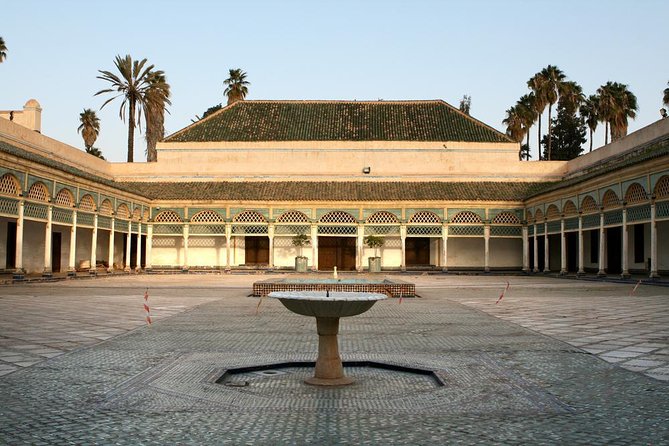
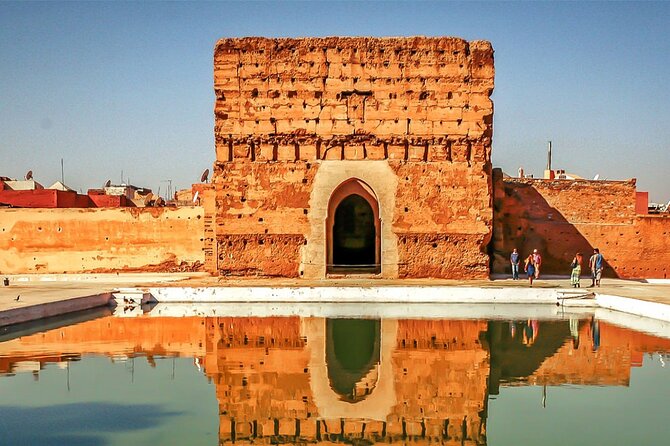
The first stop is Bahia Palace, with about an hour set aside for the visit. This is the longest stop on the route, and rightly so. The palace was begun in the 1860s by Si Musa, grand vizier under Sultan Muhammad ibn Abd al-Rahman. His son, Si Ba Ahmed ibn Musa, expanded it between 1894 and 1900 while serving as grand vizier under Sultan Moulay Abdelaziz.
Those dates help you place the building. Bahia Palace is not an ancient monument from Morocco’s earliest dynasties. It belongs to the 19th century, when powerful officials built elaborate residences that reflected political rank, wealth, and court life.
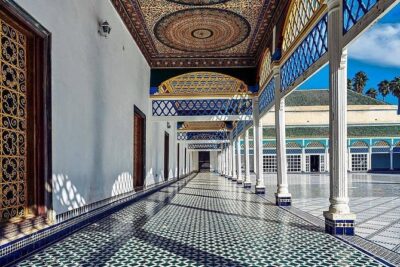
I would pay attention to the relationship between the rooms and courtyards. A guide can explain why the layout matters, how decorative details fit the period, and how a palace functioned as more than a pretty collection of tiles. Without that background, it is easy to focus only on photographs.
The hour here gives you time to look carefully, but admission is not included. You should budget for the entrance ticket separately and be prepared for the possibility that the actual time inside may vary with the pace of your group.
Bahia Palace is also a good place to see why a guide can add value. You can walk through a building on your own, but you may not know which details connect to the city’s political past or local building traditions. If architectural explanation matters to you, this is likely one of the tour’s strongest stops.
Mellah: Jewish heritage and the working market
The route then moves into Mellah, the former Jewish quarter of Marrakech. One hour is planned here, making it equal in length to Bahia Palace. This is the part of the tour that gives the walk more range than a standard palace-and-monument circuit.
The narrow lanes were once home to Marrakech’s Jewish population. The area includes Lazama Synagogue, known for its tiled courtyard and displays about Jewish life, along with the Miaara Jewish cemetery. These places offer a different view of the city’s past and show that Marrakech’s identity was shaped by more than one religious and cultural community.
The synagogue and cemetery are especially useful for understanding the Mellah as a lived neighborhood, not just a historic label. I would ask the guide to explain how the community fit into the wider city and what remains visible today. The supplied details confirm that the synagogue includes exhibits, but they do not promise that every interior area will be open during your visit, so keep your expectations flexible.
Mellah also has a present-day market side. You may pass the Mellah Market, with meat and produce, and Bab Mellah Spice Souk. The guide can explain herbs used as remedies and spices found in Moroccan cooking. That practical connection is valuable. Instead of seeing sacks of powder as colorful decoration, you get an introduction to how ingredients relate to food and traditional remedies.
This is also the point where you should be clear about shopping. The guide service says the tour explains Moroccan handicrafts, which are an important part of the economy in Morocco’s historic cities. The experience provider rejects the idea that visitors are pressured to buy things. Even so, if you prefer a purely sightseeing walk, ask at the start how much time will be spent discussing crafts or markets.
That conversation is sensible, not suspicious. Markets are part of Marrakech, and learning how goods are made can be worthwhile. But your priorities may be old buildings, photography, or history. The private format should make it easier to shape the balance.
Saadian Tombs: a short look at royal burial
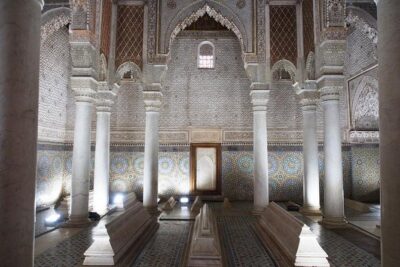
The Saadian Tombs receive about 30 minutes. They sit south of the Kasbah Mosque, inside the royal kasbah, and form a historic royal necropolis in Marrakech.
Half an hour is enough for a focused visit, but this is not a stop where you should expect a long, slow exploration. The entrance fee is not included, so factor that into the price. The guide’s role here is to explain the tombs’ place in the royal quarter and help you notice details you might otherwise miss.
The shorter timing also affects the day’s rhythm. After an hour at Bahia Palace and an hour in Mellah, the tombs provide a compact historical stop before the final visit. If you want to linger at every site, three hours may feel tight. If you prefer a clear introduction with several distinct subjects, the schedule is more efficient.
I would treat the Saadian Tombs as a concentrated visit rather than the main event. They help connect Marrakech’s royal past with the buildings and neighborhoods you have already seen.
More Historical Tours in Marrakech
- Historical Marrakech Walking Tour
★ 5.0 · 198 reviews - Half Day Guided Tour in Marrakech History & Culture
★ 5.0 · 93 reviews - Marrakech: Historical Discovery Tour
★ 4.1 · 87 reviews - Private Cultural Tour in Marrakech City
★ 5.0 · 77 reviews
Koutoubia Mosque: Marrakech’s famous landmark
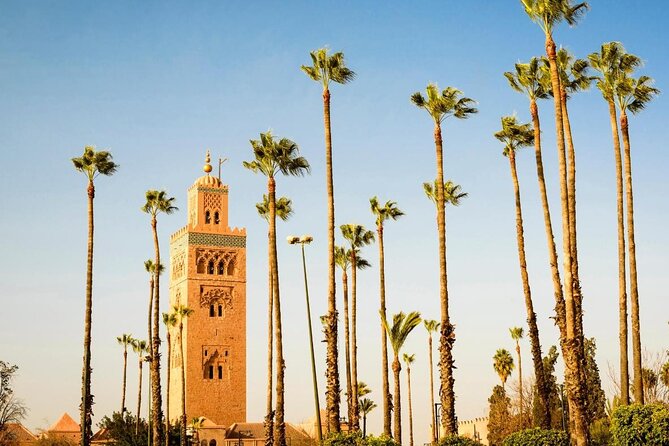
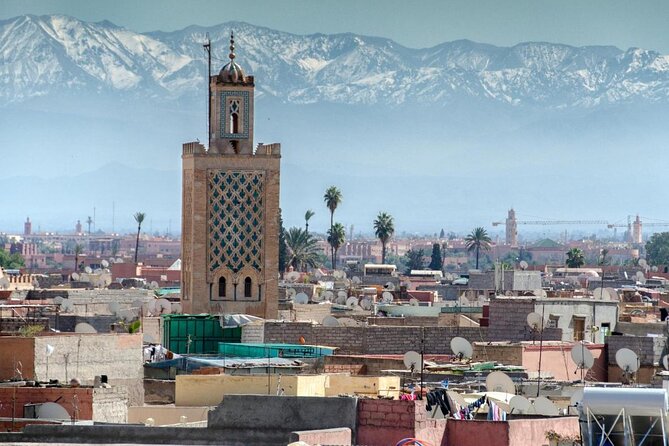
The final scheduled stop is Koutoubia Mosque, with about 30 minutes. It is the largest mosque in Marrakech and sits in the southwest part of the Medina.
The mosque is a useful closing point because it is both a major religious building and an easy landmark for getting your bearings. A guide can explain its place in the city and point out architectural features from the outside. The listed admission is free, but the tour details do not promise interior access, so you should not assume that this is an inside visit.
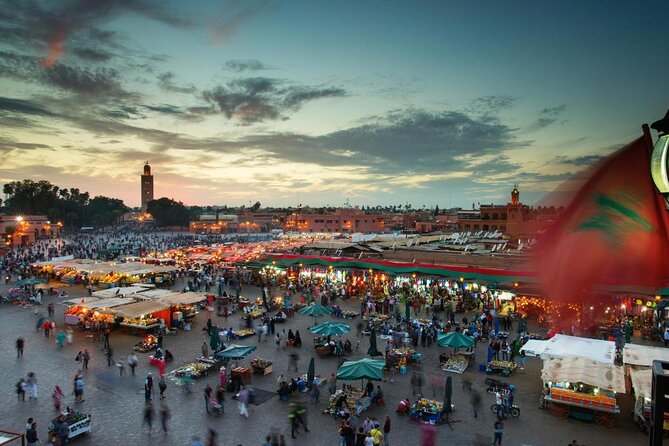
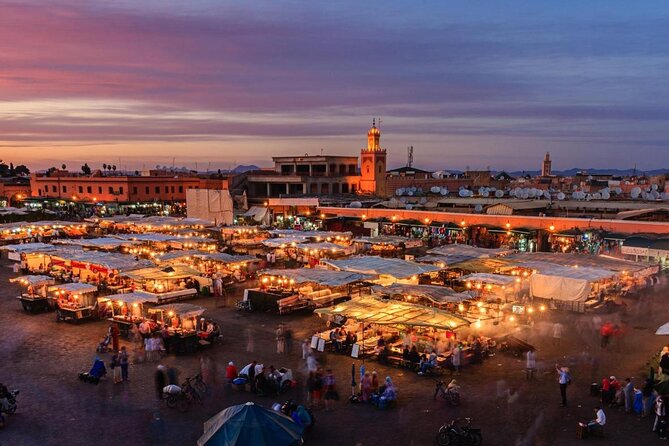
The short stop works well as an introduction. You can take in the mosque, hear the explanation, and then continue toward Jemaa el-Fna, where the tour ends. The finish gives you a natural next step for independent exploring, since you will already be near one of Marrakech’s central public spaces.
As with all religious sites, follow the guide’s instructions about access and appropriate conduct. The supplied information does not specify interior visiting rules, so it is best to view the mosque primarily as a landmark and architectural stop unless your guide says otherwise.
The guides are the main reason to book
The best part of this experience is not transportation. It is the person walking beside you.
Noura has been praised for being attentive to individual needs and for offering useful follow-up advice about restaurants, spas, and places in the souk to find high-quality crafts. That kind of help is particularly useful on your first day, when you are still deciding where to eat, shop, and spend your limited time.
Ismael, described as one of Noura’s coworkers, has been praised for his explanations of Moroccan history, architecture, and culture. His English, Arabic, and French skills are also highlighted, along with his warmth and ability to take photographs. If you care about communication or want help getting good group pictures, those are meaningful strengths.
Mohamed has also received strong praise for his guiding in Spanish, with an emphasis on history, culture, and local places. If you need Spanish, confirm language availability when booking, since the information provided does not promise a specific guide or language for every departure.
The guide’s identity is not guaranteed in advance. That is worth noting because the strongest part of the experience depends on the person assigned to your group. Still, the repeated praise for several guides suggests a broad strength in the provider’s local staff.
Is $60 per person a fair price?
At $60 per person, this is not the cheapest way to walk through the Medina. The main sites are close together, and you can reach them without paying for a vehicle. One critical assessment found that the attractions were walkable and questioned the value of a driving option, especially when the actual sightseeing involved mostly walking.
That criticism points to an important distinction. You are not buying distance. You are buying a private guide, explanations, cultural background, and a planned route through places that can be hard to interpret on your own.
The price looks more reasonable if you are visiting Marrakech for the first time, have only a short stay, or want help avoiding a disorganized first day. It is less appealing if you already know the Medina, enjoy researching monuments yourself, and are comfortable handling the markets without assistance.
Admission fees are extra, and drinks are not included. Pickup and drop-off are also excluded, so you must reach Tinsmiths Square on your own and leave from Jemaa el-Fna at the end. These are not serious problems, but they affect the true cost.
Group discounts are available, though the details of the discount are not provided. Since the activity is private and limited to your group, ask how the final price changes with group size before booking.
Timing, meeting point, and practical planning
The meeting point is Place des Ferblantiers, or Tinsmiths Square, in Marrakech’s Medina. The tour ends at Jemaa el-Fna. You should allow extra time to find the starting point, since no pickup is included.
The mobile ticket is convenient, and confirmation is provided at booking. The experience is described as suitable for most people, but the route takes place through Medina streets and includes several hours on foot. The information does not specify distance, seating, or step-free access, so contact the provider if those details affect your plans.
You can request a schedule tailored to your needs. That flexibility may help if you are fitting the tour around a train, meal, or another activity. Ask about the preferred starting time before booking, since the exact schedule is not stated.
Free cancellation is available if you cancel at least 24 hours before the local start time. Changes or cancellations made within 24 hours are not accepted for a refund. Keep that deadline in mind if your Marrakech plans are still shifting.
Who will get the most from this experience?
I would recommend this tour most strongly to first-time visitors who want a clear introduction to Marrakech. It suits people who enjoy asking questions, want historical context, and prefer a private guide instead of a large group.
It also works well for a short city break. The route covers several important areas in three hours, then leaves you at Jemaa el-Fna with the rest of the day available.
Families and small groups may appreciate the private arrangement because the pace can be adjusted. The guide can focus on the subjects that interest your group, within the time available.
I would be more cautious if your main goal is shopping, eating, or visiting every monument in detail. This is a survey walk, not a full-day archaeological tour. You will pay extra for entry tickets, and the sites are near enough to reach on your own.
Should you book the Marrakech Medina walk?
Book it if you want your first hours in Marrakech to have structure. The route gives you Bahia Palace’s courtly architecture, Mellah’s Jewish heritage, the Saadian royal necropolis, Koutoubia Mosque, and a guided look at spices and crafts.
The strongest reason to choose it is the private guide service. Noura, Ismael, and Mohamed have each been praised for clear explanations and personal attention, with Noura especially useful for restaurant, spa, and shopping advice.
Skip it if you are already comfortable navigating the Medina or want to spend $60 on independent visits and meals. The sights are walkable, and entrance fees are separate. For a first-day introduction led by a strong local guide, though, the price can be fair, especially for a small group that values context over transport.
FAQ
How long is the Marrakech historical and cultural experience?
The experience lasts approximately three hours.
Is this a private tour?
Yes. Only your group participates in the activity.
Where does the tour begin?
It begins at Tinsmiths Square, also called Place des Ferblantiers, in Marrakech.
Where does the tour end?
It ends at Jemaa el-Fna Square in Marrakech.
Which places are visited?
The route includes Bahia Palace, Mellah, the Saadian Tombs, and Koutoubia Mosque.
Are entrance fees included?
No. Entrance fees are not included in the $60 price.
Is pickup and drop-off provided?
No. Pickup and drop-off are not included.
Are drinks included?
No. Drinks are not included in the tour price.
Can the schedule be adjusted?
Yes. The tour can be tailored to fit your schedule.
What is the cancellation policy?
You can cancel for a full refund if you do so at least 24 hours before the experience start time. Changes or cancellations made less than 24 hours before the start are not accepted for a refund.
More Historical Tours
- 1 Day Guided Tour of World Heritage Kasbah Ait Ben Haddou from Marrakech
★ 3.5 · 73 reviews - Enchanting Half-Day Journey of Marrakech into History & Culture.
★ 4.5 · 72 reviews - private VIP half journey of Marrakesh : History & Culture.
★ 4.5 · 64 reviews - Marrakech: Historical Private Tours – Half-Day
★ 4.5 · 58 reviews
Just added around Marrakech
- Marrakech: Medina Souks, Hidden Markets and Shopping Tour★ 4.8 · 33 reviews
- Agafay desert sunset camel ride Tour from Marrakech★ 5.0 · 33 reviews
- Guided walking tour in Marrakech★ 4.5 · 33 reviews
- Sunset Camel Ride Marrakech with Transfers★ 5.0 · 33 reviews
- 2 Days Desert Agafay and Atlas Mountains Trek From Marrakech★ 3.8 · 33 reviews
- Atlas mountains, Ourika valley, berber villages trip & Guide★ 5.0 · 33 reviews
- Magical Dinner show and Quad bike In Agafay Desert Marrakech★ 4.5 · 33 reviews
- Marrakech: Ouzoud Waterfalls Trip, Guide & Boat + Lunch★ 4.7 · 33 reviews
Historical Tours, compared.
Marrakech Historical and Cultural Tour – Half Day City Tour
Read our review →
Full-day Historical Meknes Volubilis and Moulay Idriss Tour
Read our review →
Casablanca Cultural Tour: Medina, Views & Local Delights
Read our review →
Casablanca to Fez: Scenic & Historical Day Trip with Lunch
Read our review →
A Guided Walking Tour Through the Historic Medina
Read our review →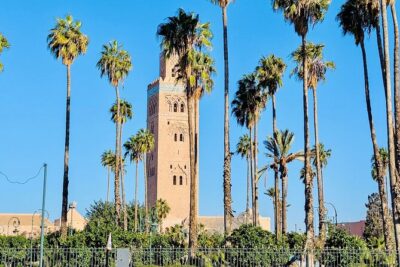
Half Day Guided Tour in Marrakech History & Culture
Read our review →Browse the lists this tour appears in