
Reviewed · CITY TOURS
Tour guide in the old city of Fez
Fez rewards curious walkers. This two-hour tour with Rachid brings you through Fes el-Bali, where old mosques, spice markets, leather workshops, and narrow lanes still shape daily life. I like the focus on local crafts and the chance to see places such as Chouara Tannery and Souk Attarine with context, not just a quick photograph. I also like the small-group limit of 10 people, which should make it easier to hear the guide in the crowded medina.
The price is reasonable at $29.08 per person, especially if you want help finding your way through Fez’s famously confusing lanes. Still, the itinerary is ambitious for only two hours, and one serious complaint describes a customer being left in the medina without proper guidance. The operator apologized and said a refund was provided, so confirm the meeting details clearly before setting out.
In This Review
- Key points to know before walking into Fez
- Why a guide matters in Fes el-Bali
- Kairaouine Mosque and the religious heart of Fez
- Sidi Ahmed Al-Tijani Zawiya and living devotion
- The Royal Palace gates in Fez
- Al-Attarine Madrasa and Marinid design
- Bab Boujloud, the easiest place to get your bearings
- One hour inside Fes el-Bali
- Souk Attarine, where Fez smells like herbs and perfume
- Dar Batha Museum and Moroccan arts
- Chouara Tannery and Fez’s leather tradition
- Zaouia of Moulay Idriss II from the street
- Is $29.08 a fair price for two hours?
- Who should book this Fez walking tour?
- Should you book it?
- FAQ
- How long does the Fez walking tour last?
- Who leads the tour?
- How large can the group be?
- Is the tour entirely on foot?
- Is admission to Al-Attarine Madrasa included?
- Can foreign tourists enter the Royal Palace?
- Can foreign tourists enter the Zaouia of Moulay Idriss II?
- What is the cancellation policy?
Key points to know before walking into Fez
- Rachid leads the walk: The experience is built around a local guide who explains Fez’s culture, crafts, religious sites, and daily routines.
- Fes el-Bali takes up half the tour: About one hour is allocated to the old medina, with the remaining time divided among major sights.
- Chouara Tannery is a highlight: You can see the traditional leather-making area and learn why Fez is famous for leather goods.
- Several major sites are viewed from outside: The Royal Palace and Zaouia of Moulay Idriss II do not offer full interior access to foreign tourists.
- Al-Attarine Madrasa costs extra: Admission is not included there, unlike several of the other listed stops.
- It is entirely on foot: The tour is described as easy and suitable for most people, but Fez’s old city has narrow, winding lanes and plenty of walking.
Why a guide matters in Fes el-Bali
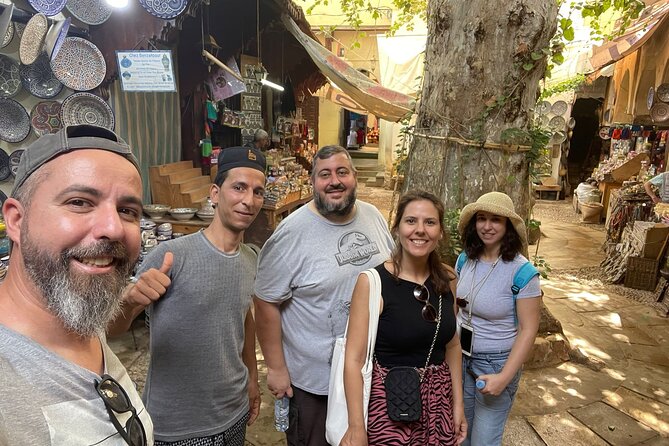
Fez is not a city you understand by checking off monuments. Its old city is a working district, a religious center, a shopping area, and a maze of lanes all at once. Fes el-Bali has retained its old form, with streets that branch, twist, and narrow without warning.
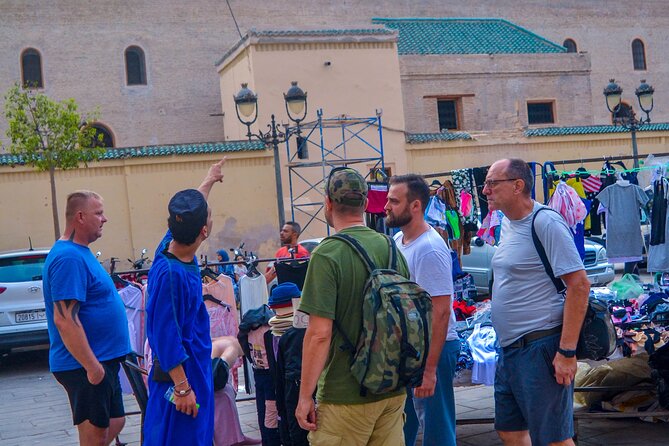
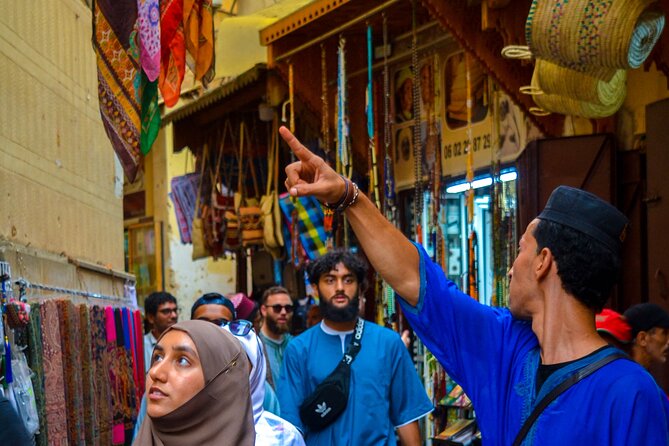
That is where Rachid’s role can add real value. A local guide can explain why one lane smells of mint and herbs, another displays copperware, and another leads toward leather workshops. Without context, the medina can feel like an attractive blur of doors, stalls, and passing shoppers. With a guide, the details begin to connect.
I also like the tour’s stated interest in responsible tourism. The plan is to support local shops and craftspeople rather than treat the medina as a stage set. That matters in Fez, where traditional work still includes leather, tile, wood, textiles, metal, spices, and handmade goods.
The main limitation is time. Ten stops in roughly two hours means many visits last only 10 or 15 minutes. You should view this as an orientation walk, not a slow museum tour. It gives you a useful first look and helps you decide where to return later.
More City Tours in Fez
- Blue City magic: Affordable Day Trip from Fez to Chefchaouen
★ 4.6 · 1,960 reviews - Private Half-Day Tour of the Authentic City of Fez
★ 5.0 · 199 reviews - Day Trip to Chefchaouen the blue city
★ 4.0 · 187 reviews
Kairaouine Mosque and the religious heart of Fez
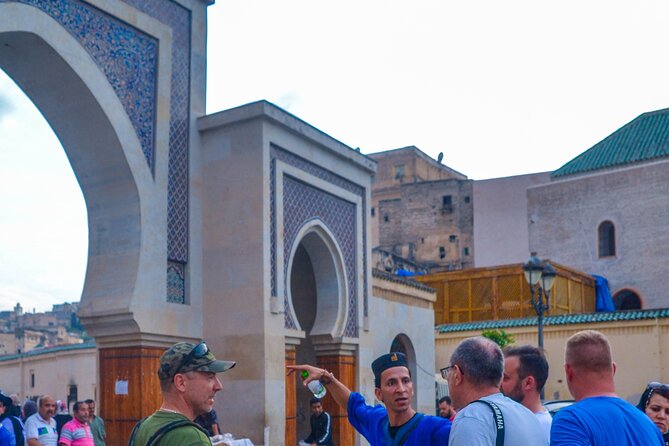
The first stop is Kairaouine Mosque, also written as Al-Qarawiyyin. Its construction was completed in 859 AD on the orders of Fatima bint Muhammad al-Fihri, and it became one of Fez’s central religious and educational institutions.
The mosque was expanded over the centuries. The Zenati princes, with help from the Andalusian Umayyads, added about 3,000 square meters, and the Almoravids later enlarged it again. Its 17 doors and broad layout reflect the importance the mosque gained as Fez grew.
The stop lasts about 10 minutes. That is enough for Rachid to explain the site’s origins and point out its place in the city, but not enough for a long architectural study. Admission is included, though access inside religious buildings can depend on local rules. The value here is the explanation and setting, especially if this is your first introduction to Fez.
Sidi Ahmed Al-Tijani Zawiya and living devotion
The Zawiya of Sidi Ahmed al-Tijani sits in the Al-Blida neighborhood, close to the University of Al Quaraouiyine. It is a religious complex dedicated to Sheikh Ahmad al-Tijani, the 18th-century founder of the Tijaniyyah order, who is buried at the site.
The word zawiya refers to an Islamic religious complex used for teaching, prayer, and commemoration. This one is easy to recognize from its decorated street-facing walls and turquoise minaret.
You have about 10 minutes here, with admission included. The stop is less about entering every room and more about understanding how religious institutions fit into the fabric of the medina. I would listen closely to Rachid at this point, since a short explanation can make the building far more meaningful than its colorful exterior alone.
The Royal Palace gates in Fez
Fez’s Royal Palace, or Dar el-Makhzen, was built in the 1960s. You cannot tour the palace grounds, but you can view its famous gates, marked by Moroccan tilework, carved wood, and large copper details.
The seven gates are the main attraction for a short stop. They offer strong photo opportunities and a good example of Moroccan decorative design, but this is not a palace visit in the usual sense. You will not wander through royal rooms or gardens.
The tour allows about 10 minutes here. That timing makes sense because the experience is limited to the exterior. Keep your expectations clear: you are seeing the entrance architecture, not exploring the residence.
A few more Fez trips worth weighing up
- Chefchaouen Day Trip from Fez (Shared Group Tour)
★ 4.6 · 2,394 reviews - Fes: Volubilis Roman Ruins, Mouly Idriss, & Meknes Day Trip
★ 4.6 · 2,375 reviews - Fez Medina Guided Tour
★ 4.6 · 2,079 reviews - From Fez: Sahara Desert 2-Day Tour with Merzouga Camp Stay
★ 4.8 · 1,716 reviews
Al-Attarine Madrasa and Marinid design
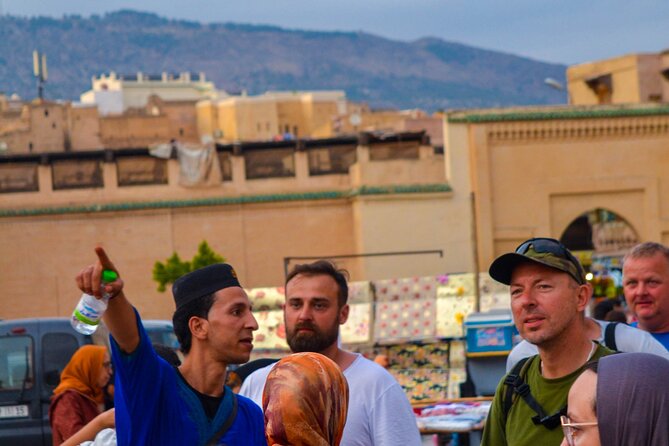
The Al-Attarine Madrasa is one of the most rewarding architectural stops in the old city. Built between 1323 and 1325 under Marinid Sultan Uthman II Abu Said, it was designed as a school near the Kairaouine Mosque and the perfume market.
The building is admired for its careful use of limited space. Marinid builders filled the madrasa with tilework, carved plaster, wood, and patterned decoration without making the rooms feel chaotic. Its name comes from Souk al-Attarine, the nearby market associated with spices and perfumes.
You get about 15 minutes here, but admission is not included. That extra cost is worth considering if you care about Islamic architecture. Of all the paid elements in this walk, this is the one I would be most likely to add, since the interior offers a closer look at Moroccan design than the palace gates do.
The itinerary also names Al-Attarine Madrasa again later, but that second reference describes Souk Attarine, the market beside the mosque. Treat these as two different places: one is a historic school, and the other is a commercial lane filled with perfume, herbs, and traditional remedies.
Bab Boujloud, the easiest place to get your bearings
Bab Boujloud is one of Fez’s best-known gates and a practical reference point for the old city. It sits on the northwest side of the walled medina near Al-Basha Al-Baghdadi Square.
Many people use it as the main entrance to Fez’s old city. The gate also sits near the Bou Inania Madrasa, whose minaret can be seen as you approach. The stop lasts about 10 minutes, with admission included.
This is a useful point in the walk because Fez can disorient you quickly. Even if you do not remember every turn afterward, knowing Bab Boujloud gives you a fixed place to return to. I would take a clear mental note of the gate and nearby square before moving deeper into the lanes.
One hour inside Fes el-Bali
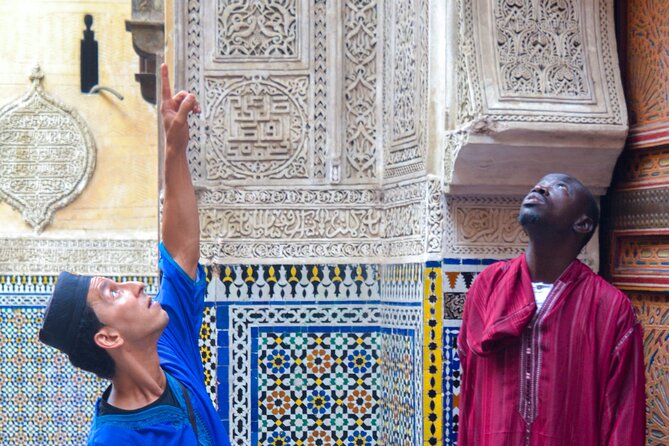
The longest part of the experience is a one-hour walk through Fes el-Bali. This is the core of the tour, and it is where Rachid’s local knowledge matters most.
The old city is often described as one of the largest ancient urban areas that still retains its original form. Its main gate is Bab Boujloud, while the streets spread into separate areas on either side of a winding river. The north bank contains many historic monuments and markets. The south bank has narrower lanes associated more closely with local life.
Expect pedestrian streets, changing smells, small shops, artisans at work, and routes that seem to turn back on themselves. The tour description promises access to corners many people miss, along with meetings with craftspeople and opportunities to sample local food. Since the time is limited, the exact amount of shopping, tasting, or workshop time may depend on the day and the pace of the group.
This section is also where you should stay close to Rachid. A complaint about being left in the medina without directions is a serious warning, even though the operator said it was an unusual problem and that the customer received a refund. Before the walk begins, make sure you know the guide’s appearance, phone contact, and exact meeting point.
Souk Attarine, where Fez smells like herbs and perfume
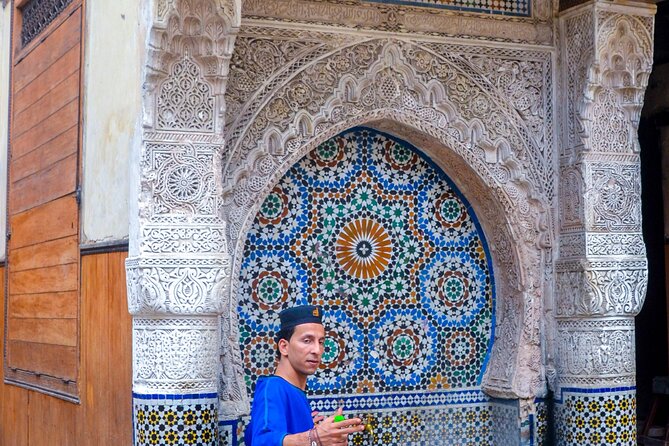
Souk Attarine lies near Kairaouine Mosque in the heart of Fes el-Bali. It is known for shops selling perfumes, herbs, medicinal plants, and traditional remedies.
The market was once closely linked to traditional medicine. Today it remains a busy commercial lane with many small shops and two large doors that close in the evening. The 10-minute stop gives you a quick look at one of the medina’s most distinctive shopping areas.
This is a good place to use your senses, but do not rush into buying something simply because it smells pleasant. Ask Rachid what an item is used for and whether it is a common local product. A guide who encourages fair dealing and support for local businesses can help keep the shopping part useful rather than pushy.
Dar Batha Museum and Moroccan arts
Dar Batha was completed in 1897 by Sultan Moulay Abdel Aziz, building on work begun by his father, Moulay Hassan. It began as a summer residence for royal receptions and became a regional museum of arts and customs in 1915.
The museum holds about 6,000 objects, including manuscripts, astrolabes, copper, wood, plaster, marble, coins, jewelry, clothing, textiles, and ceramics. The brick room is described as a particular point of interest.
The tour allows only 10 minutes at the museum, so expect a brief visit rather than time to study the collection. Admission is included. If you like decorative arts, this stop may leave you wishing for another hour. Still, it gives you helpful context for the crafts you see in the markets, especially tilework, wood carving, metalwork, and pottery.
Chouara Tannery and Fez’s leather tradition
Chouara is the most famous tannery in Fez and one of the clearest examples of an old craft still operating in the medina. Fez has long been known for leather goods, and the tanners’ souk supplies much of that trade.
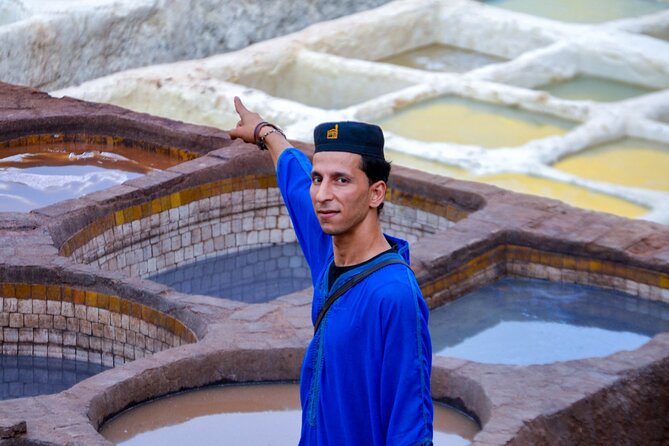
The tannery area includes large traditional dyeing and treatment vats. From an upper viewpoint, you might see workers handling hides and the colored materials used in the process. The distinctive smell is part of the experience, and shops near the tannery may offer leather bags, slippers, belts, and other goods.
The visit lasts about 15 minutes. That is enough to understand the basic process and see the working area, but it is not a full workshop visit. If you are sensitive to strong odors, prepare yourself. The smell is not a side issue here. It is one of the most memorable parts of the stop.
I value this portion because it connects history to present-day work. You are not looking at a craft locked behind glass. You are seeing an old trade that still supports local makers, even though the conditions can be intense.
Zaouia of Moulay Idriss II from the street
The mausoleum of Moulay Idriss II is another important religious site in the old city. Moulay Idriss II is closely tied to the early development of Fez, and the shrine remains a meaningful place for Moroccan visitors.
Foreign tourists are not allowed to enter the mausoleum, so you will view it from outside and take photographs. Moroccan visitors may cross the threshold and see the tomb, which is enclosed by a wooden frame and covered with a red cloth bearing Quranic verses.
The tour gives this stop about 10 minutes. It is best approached with respect and modest expectations. You are seeing the entrance and learning about the site’s religious role, not touring the interior. Rachid’s explanation can help you understand why access differs for Moroccan and foreign visitors.
Is $29.08 a fair price for two hours?
At $29.08 per person, the tour costs about $14.54 per person for each hour of a two-hour walk. That is fair if you want a private-feeling orientation with a local guide, especially when the group reaches the maximum of 10 people.
The value comes less from admission tickets. Several stops are exterior views or brief explanations, and Al-Attarine Madrasa requires separate admission. You are paying mainly for navigation, local interpretation, and a structured route through a place that can be difficult to understand alone.
The price is strongest for a first visit to Fez. If you already know the medina well, you may prefer spending the same time at one museum, one madrasa, or one market at your own pace. You might also need a second visit to properly enjoy the sites that receive only 10 or 15 minutes.
Who should book this Fez walking tour?
I would recommend it to first-time visitors who want an overview before exploring alone. It also suits anyone interested in architecture, religious sites, traditional crafts, markets, and the working life of the medina.
The walk is described as easy and suitable for most people. It is entirely on foot, though, and the old city’s lanes can be narrow and uneven. You should be comfortable walking for about two hours and staying with the group.
It may not suit you if you want long museum visits, palace interiors, or a relaxed food tour. The itinerary covers a lot of ground, so the pace is likely to feel brisk. Confirm whether food sampling is included in your specific departure, since the general description mentions local cuisine but does not give a set tasting menu.
Confirmation is sent within 48 hours of booking, subject to availability. A mobile ticket is provided, service animals are allowed, and free cancellation is available up to 24 hours before the start time. Changes or cancellations inside that 24-hour window are not refunded.
Should you book it?
Book this tour if you want a reasonably priced introduction to Fez with a local guide and a strong emphasis on the medina’s crafts and religious landmarks. Rachid’s passion for his city, the hour in Fes el-Bali, and the visit to Chouara Tannery are the main reasons to consider it.
Before paying, confirm the meeting point and guide contact details in writing. The one complaint about being left without directions should not be ignored, even though the operator apologized and reported issuing a refund. If that practical detail is clear, this can be a useful first walk, followed by slower independent visits to Al-Attarine Madrasa, Dar Batha, and the markets that catch your interest.
FAQ
How long does the Fez walking tour last?
The tour lasts approximately two hours. The itinerary includes one hour in Fes el-Bali, with the remaining time divided among the listed landmarks and markets.
Who leads the tour?
The tour is led by Rachid, a local guide who explains Fez’s history, culture, daily life, religious sites, and traditional crafts.
How large can the group be?
The maximum group size is 10 travelers.
Is the tour entirely on foot?
Yes. The activity is described as a walking tour with no transportation included.
Is admission to Al-Attarine Madrasa included?
No. Admission to Al-Attarine Madrasa is not included. Several other listed stops have admission included, but some sites are viewed from outside.
Can foreign tourists enter the Royal Palace?
No. The Royal Palace grounds are not open to tourists on this experience. You view the decorated gates from outside.
Can foreign tourists enter the Zaouia of Moulay Idriss II?
No. Foreign tourists are not allowed to enter the mausoleum and view it from the exterior.
What is the cancellation policy?
You can cancel up to 24 hours before the experience begins for a full refund. Cancellations or changes made less than 24 hours before the start time are not refunded.
Just added around Fez
- day trip from fez to middle atlas mountain★ 5.0 · 17 reviews
- Volubilis and Meknes day trip from Fez★ 4.5 · 17 reviews
- Private 4 Days Desert Tour from Fes to Marrakech★ 5.0 · 17 reviews
- Fes: Authentic Cooking Class and Old Medina Visit★ 4.9 · 17 reviews
- Half Day Guided Walking Tour in the Medina of Fez★ 5.0 · 17 reviews
- Discover Fez and it’s hidden secrets with a local★ 5.0 · 17 reviews
- Fes with the Hidden Alleys to Explore★ 5.0 · 17 reviews
- Day trip to Volubilis and Meknes from Fez★ 5.0 · 17 reviews
City Tours, compared.
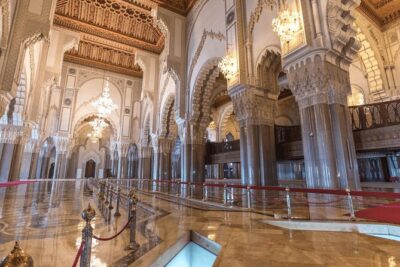
Casablanca City Tour with Hassan II mosque ticket
Read our review →
Blue City magic: Affordable Day Trip from Fez to Chefchaouen
Read our review →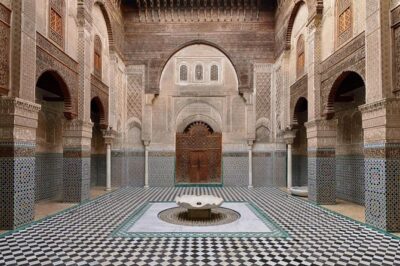
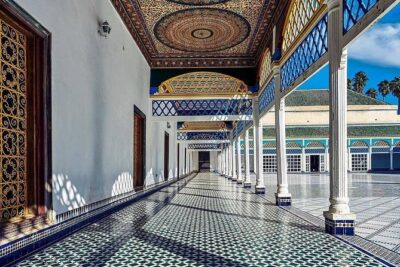
Marrakech Historical and Cultural Tour – Half Day City Tour
Read our review →
Browse the lists this tour appears in