
Reviewed · MEDINA AND SOUK WALKS
5-Hour Private Walking Tour of the Medina in Fez
Fez rewards patient walkers. This private tour gives you a local guide, a flexible route, and five to six hours to make sense of the medina’s twisting lanes, grand gates, religious schools, Jewish quarter, and working tanneries. I especially like the chance to adjust the route to your interests and the useful orientation a private guide can provide on a first visit.
The strongest parts are the human scale and the local contact. Guides such as Hassan, Rachid, and Kamal have helped guests feel at ease, explain the city clearly, and, when asked, move away from the usual stops toward smaller workshops and less familiar corners. The main drawback is that the tour involves a lot of walking over uneven streets, and the published timing is slightly unclear: it is described as five hours in one place and six hours in another.
In This Review
- Key points to know before booking
- Why a private walk helps in Fez
- The Royal Palace gates and the Fes el-Jdid beginning
- One hour in the Mellah, Fez’s Jewish quarter
- Entering the medina through Bab Boujloud
- Bou Inania Medersa and Marinid artistry
- Nejjarine Museum and the craft of wood
- Al-Qarawiyyin, a working center of learning
- Chouara Tannery and the city’s strongest sensory stop
- Timing, walking, and what the day feels like
- Is $30 per person good value?
- Who should book this Fez walking tour?
- FAQ
- How long does the private Fez walking tour last?
- Is this a private tour?
- What sights are included on the route?
- Is hotel or station pickup available?
- Are entrance fees included?
- Is food or drink included?
- How much does the tour cost?
- Is the tour suitable for children?
- What happens if I need to cancel?
- Should you book it?
Key points to know before booking
- A genuinely private experience: Your group has its own local guide, so you can ask questions, slow down, or request more time at places that interest you.
- Six major Fez sights: The route includes the Royal Palace gates, Mellah, Bab Boujloud, Bou Inania Medersa, Nejjarine Museum, al-Qarawiyyin, and Chouara Tannery.
- Useful for first-time visitors: A guide helps you get your bearings in the famously confusing Fes el-Bali medina.
- Strong personal service: Hassan adapted the route for local photography, while Rachid and Kamal received praise for their care and clear explanations.
- Good price for a private guide: At $30 per person, the tour can offer solid value, especially if you are sharing it with family or friends.
- Plan for a physical morning or afternoon: Expect several hours on foot, all-weather exposure, and little time for a full meal during the route.
Why a private walk helps in Fez
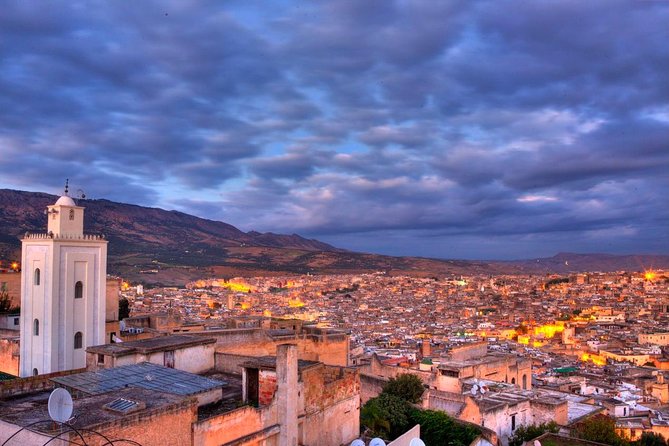
Fez is not a city I would want to meet for the first time without a plan. The old medina is a web of narrow lanes, covered passages, tiny squares, workshops, mosques, food stalls, and doorways that can look almost identical after a while. A private guide gives you a human map.
That matters most at the start of a visit. You can ask where the main routes run, how the old city is organized, and which sights deserve a longer look. You also have someone to explain local customs around religious buildings, shops, and residential areas.
The private format is more than a smaller group. It lets you shape the pace. If you care about architecture, you can spend longer with the zellij tilework and carved cedar. If you like photography, you can ask for quieter lanes and better angles. Hassan did exactly this for one group, taking them away from the usual tourist path after learning that local photography was the priority.
Rachid also earned praise for being attentive to individual needs and for introducing a solo guest to local craft workshops and less familiar parts of the medina. Kamal met one guest at the Fez railway station and then spent six calm hours explaining the city and its sights. Those details suggest that the quality of the experience depends heavily on the guide assigned to you, but the private setup gives a good guide room to personalize the day.
More Medina and Souk Walks in Fez
- Fez Medina Guided Tour
★ 4.6 · 2,079 reviews - Fes: Museum, Al Attarine Madrasa & Tannery and Medina Tour
★ 4.6 · 1,655 reviews - Explore Fes: Unforgettable Guided Walking Tour of the Medina
★ 4.7 · 1,339 reviews
The Royal Palace gates and the Fes el-Jdid beginning
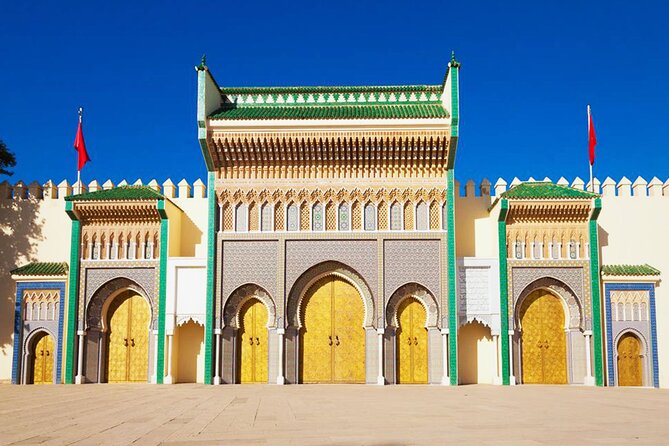
The tour begins at the Royal Palace of Fez, known as Dar el-Makhzen, in the Fes el-Jdid district. The palace itself remains a working royal residence, so you do not go inside. Your stop is focused on the grand exterior and its famous golden bronze gates.
Allow about 15 minutes here. That may sound brief, but the ornate gates make a strong opening photograph. Look for the blue and green zellij tilework, carved cedar, and stucco details. The design shows the care given to Moroccan craft traditions, even at a building that is closed to the public.
This first stop also gives useful political context. The palace reflects Fez’s long role as one of Morocco’s Imperial Cities and as a center of royal administration. You will not see gardens or interior courtyards, so keep expectations in check. This is an exterior viewing stop, not a palace tour.
One hour in the Mellah, Fez’s Jewish quarter
The Mellah is one of the most worthwhile parts of the route because it adds a different layer to Fez’s story. Established in the 15th century near the Royal Palace, it was Morocco’s oldest Jewish quarter and home to a Jewish community involved in trade and crafts.
You spend about an hour here, with admission to the included sites. The architecture gives you clues about the old neighborhood’s distinct character. Houses often have outward-facing wooden balconies and several stories, unlike the inward-looking design common in many Muslim quarters.
The Ibn Danan Synagogue dates from the 17th century, and the Jewish Cemetery contains tombs facing Jerusalem. These places make the Mellah more than a quick photo stop. They help you understand how Jewish and Muslim communities shaped Fez side by side, even within a system that kept them apart.
The quarter also carries a note of loss. Most Jewish residents left after the middle of the 20th century, and some lanes now feel weathered and quiet. A good guide can explain that change without reducing the Mellah to a simple story of harmony. You get a more honest picture of coexistence, separation, trade, faith, and migration.
Entering the medina through Bab Boujloud
Bab Boujloud is the famous western entrance to Fes el-Bali, the UNESCO-listed old medina. Its blue tilework makes it one of Fez’s easiest landmarks to recognize. The gate was built in 1913, so it is not a medieval structure, even though it frames a much older city.
Spend a few minutes studying both sides. The outer façade is blue, while the inside is green, a color associated with Islam in Morocco. Geometric zellij patterns and horseshoe arches give the gate its unmistakable Moroccan appearance, while its date reveals a more recent period of change.
This is a useful orientation point. From here, the old city quickly becomes a maze of lanes and covered passages. The gate connects the more modern city with the medieval medina, and your guide can help you understand that transition before the route becomes more confusing.
Bab Boujloud is also a busy place, so keep your belongings secure and stay close to your guide when crossing into the old city. The tour is private, but the public streets are shared with pedestrians, vendors, and working traffic.
More Walking Tours in Fez
- Exclusive Fez Medina Walking Tour with Private Guide
★ 5.0 · 392 reviews - Fez: Guided Walking Tour of the Historic Medina
★ 5.0 · 359 reviews - Fez Medina 4-Hour Guided Walking Tour
★ 4.5 · 248 reviews - Private walking tours Fez Medina
★ 4.5 · 164 reviews
Bou Inania Medersa and Marinid artistry
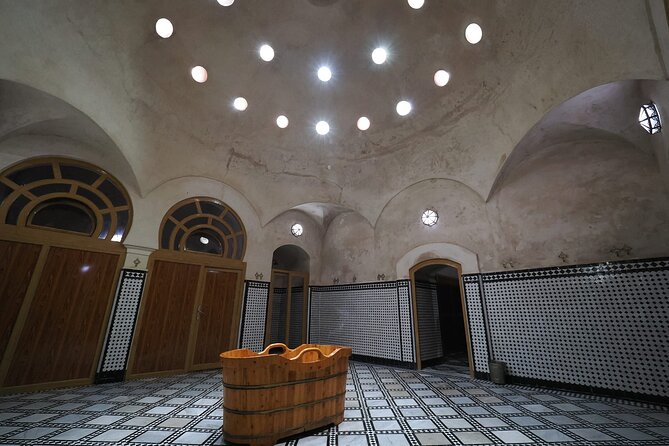
The Bou Inania Medersa is one of the architectural highlights. Built between 1351 and 1356 under Sultan Abu Inan Faris, it served as both a theological college and a mosque. It is also one of the few religious sites in Fez open to non-Muslim visitors.
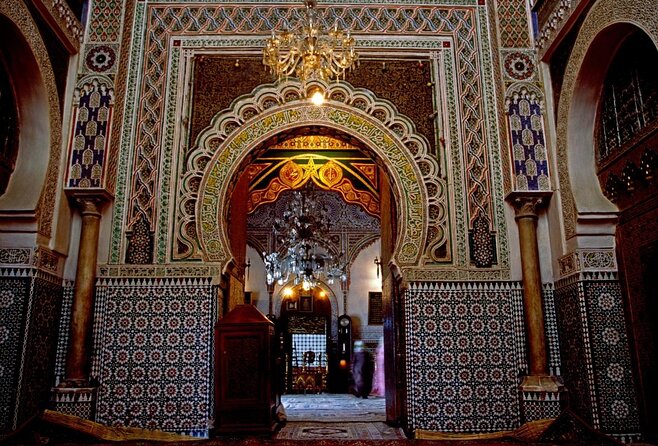
You have about 30 minutes inside. That is enough to appreciate the courtyard, but you will need to look carefully. The details come in layers: geometric zellij mosaics, carved cedarwood, molded stucco, Quranic calligraphy, and a marble ablution fountain.
The green-tiled minaret rises above the medersa, while the prayer hall contains a gold-leaf mihrab. Your guide’s explanation is especially valuable here because the building is not simply decorative. It was designed for worship and study, with scholars learning Islamic law, theology, and related subjects.
This stop can feel dense with information, so ask your guide to point out one or two details rather than trying to absorb everything at once. The medersa is beautiful, but the floor may be uneven and the tour does not provide unlimited time for quiet architectural study.
Nejjarine Museum and the craft of wood
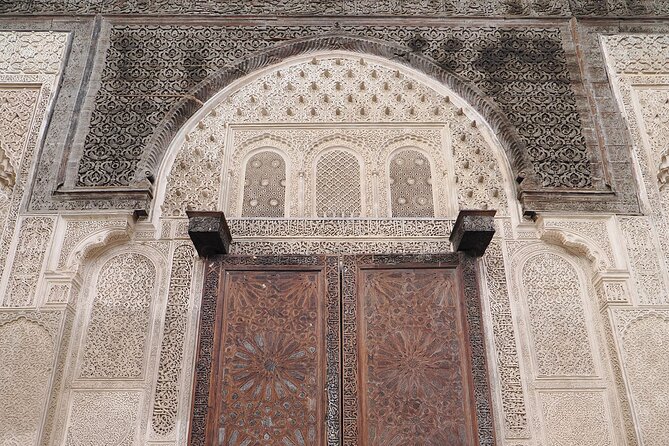
The Nejjarine Museum occupies a restored 18th-century funduq, or caravanserai. These buildings once provided lodging and storage for merchants on the road. The setting helps you picture Fez as a trade center, not only as a collection of religious monuments.
The museum focuses on Moroccan woodworking. Displays include traditional tools, furniture, and musical instruments. The courtyard combines carved cedar, zellij, and a marble fountain, so the building itself is part of the exhibit.
Plan on about an hour here. That makes it one of the longer stops and gives you time to notice how practical objects can also carry fine decoration. The rooftop terrace offers views across the medina, providing a welcome change after the narrow lanes below.
For many people, this is where the city’s craft traditions become easier to understand. You have already seen tile, stucco, metal, and wood at the palace and medersa. Here, the focus shifts to the tools and objects made by craftspeople over generations.
The museum may be less immediately famous than the tanneries, but I consider it one of the more useful stops. It gives context before you encounter the workshops and shops deeper in the medina.
Al-Qarawiyyin, a working center of learning
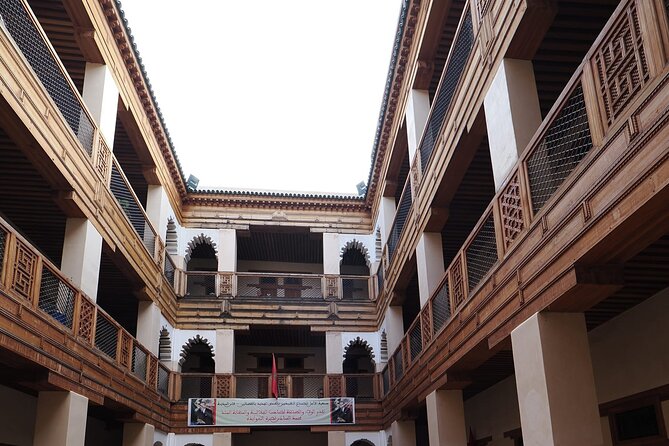
The Mosque and University of al-Qarawiyyin is one of Fez’s most important institutions. Fatima al-Fihri founded it in 859 CE, and it is recognized by UNESCO and Guinness World Records as the oldest existing degree-granting university in the world.
The tour allows about 15 minutes here, and admission is free. Since the mosque and university still function, access is limited. You should expect an exterior or restricted look rather than a full walk through every part of the complex.
Even with a short stop, the site deserves attention. The complex includes a large courtyard, a hypostyle prayer hall, carved cedar, detailed stucco, and a green-tiled minaret. Its library holds important manuscripts, including 9th-century Qurans, though this tour does not promise entry to the library.
The key value is the story. Fez was not only a place of palaces and markets. It was also a center for study in theology, law, astronomy, and languages. Your guide can connect the building to that wider intellectual role.
Because this is an active religious institution, dress modestly and follow your guide’s instructions. The short visit is a reminder that some of Fez’s most important sites are still part of daily life, not museum pieces.
Chouara Tannery and the city’s strongest sensory stop
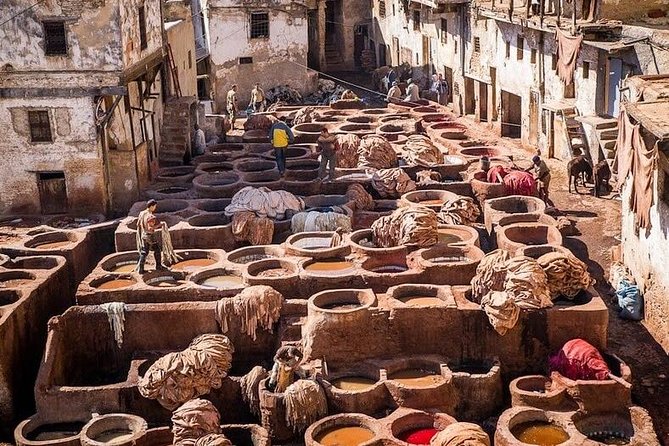
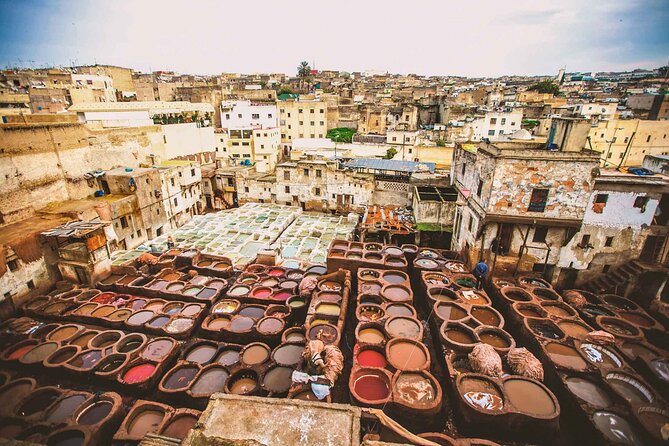
The Chouara Tannery is usually the most memorable and the most demanding stop. Its stone dyeing pits have been used for centuries, and the work still follows traditional methods. Hides are treated, softened, and dyed in open vessels using natural colors such as saffron yellow, poppy red, and indigo blue.
You view the tannery from surrounding terraces rather than walking among the pits. From above, the vessels form a striking pattern of color. The view explains why this is one of Fez’s signature sights, but the smell is equally hard to ignore.
Mint sprigs are offered to help with the odor. Take them. The scent comes from the old leather-treatment process, including the use of pigeon dung to soften hides. This is not a polished attraction, and that is part of its value. You are seeing a working craft that preserves pre-industrial methods.
The stop lasts about an hour. That gives you time to look at the dyeing process and learn how leather moves from raw hide to finished goods. Be aware that the surrounding terraces may also display leather products. The tour data does not promise shopping-free sightseeing, so make your preferences clear if you do not want to browse.
I would not judge the tannery only by its smell. It offers one of the clearest links between Fez’s old trade economy and its present-day craft production. Still, anyone sensitive to strong odors should prepare for an intense few minutes.
Timing, walking, and what the day feels like
The experience is advertised as approximately five hours, while the main description also calls it a six-hour tour. The listed stop times add up to about four hours, before counting the walking between sites. In practice, that suggests a half-day route with time spent moving through the medina and listening to explanations.
The route is not a gentle sightseeing stroll. You need a moderate level of physical fitness, and you should expect uneven lanes, steps or changes in pavement, and long periods on your feet. Wear practical shoes and dress for the weather because the tour operates in all conditions.
Food and drinks are not included. Since the schedule is full, eat beforehand or ask your guide about a suitable break when you meet. Do not assume that admission is covered everywhere. The detailed stops identify included admission at the Mellah, Bou Inania Medersa, and Nejjarine Museum, while the general tour information says entrance fees are not included. Confirm the exact inclusions before you pay for any site.
Pickup is offered, and one guest was met at the Fez station, but the exact pickup arrangement should be confirmed when booking. The tour may be operated by a multilingual guide, and children must be accompanied by an adult. Service animals are allowed, and the route is near public transportation.
Is $30 per person good value?
At $30 per person, this is a competitive price for a private half-day guide in Fez. The value improves if two or more people share the booking, since you receive personal attention without joining a large group.
You are paying mainly for orientation, interpretation, and flexibility. The palace gates and Bab Boujloud are free to view, and al-Qarawiyyin has free admission. The value comes from understanding what you are seeing and finding your way through a city that can be confusing on your own.
The price is less attractive if you want a slow museum visit, extensive shopping time, or a full meal break. The scheduled route covers many important places, so some stops are necessarily short. Still, for a first introduction to Fez, the combination of major landmarks and local guidance makes the cost reasonable.
Free cancellation is available if you cancel at least 24 hours before the start time. Changes or cancellations made later are not refunded, and the experience requires a minimum number of participants. If the provider cancels because that minimum is not met, you receive another option or a full refund.
Who should book this Fez walking tour?
I would choose this tour if you are visiting Fez for the first time, want a private guide, and prefer local explanation over a rigid sightseeing script. It is also a good fit for photographers, families with older children, and small groups who want to set their own pace.
The experience suits you especially well if you want to see both famous monuments and everyday craft traditions. Hassan’s photography-focused adjustment shows what the private format can offer when you explain your priorities early.
You may want a different plan if long walks are difficult, strong smells are a serious problem, or you prefer to explore completely alone. The medina is rewarding, but this is not a relaxed café crawl. It is an active route through historic streets, working neighborhoods, and religious sites.
FAQ
How long does the private Fez walking tour last?
The experience is described as approximately five hours, while the main tour description calls it six hours. The listed sightseeing stops total about four hours, with additional time for walking between them.
Is this a private tour?
Yes. Only your group participates, and a local guide leads the walking tour.
What sights are included on the route?
The route includes the Royal Palace exterior, Fez Mellah, Bab Boujloud, Bou Inania Medersa, Nejjarine Museum, Mosque and University of al-Qarawiyyin, and Chouara Tannery.
Is hotel or station pickup available?
Pickup is offered. One recorded experience included a guide meeting a guest at Fez railway station, but you should confirm your specific pickup point when booking.
Are entrance fees included?
Admission is identified as included for the Mellah, Bou Inania Medersa, and Nejjarine Museum. Al-Qarawiyyin is listed as free. The general information also says entrance fees are not included, so confirm the exact fee arrangement before the tour.
Is food or drink included?
No. Food and drinks are not included in the tour price.
How much does the tour cost?
The listed price is $30 per person. Group discounts are offered.
Is the tour suitable for children?
Children can take part, but they must be accompanied by an adult. All participants should be prepared for several hours of walking.
What happens if I need to cancel?
You can receive a full refund if you cancel at least 24 hours before the local start time. Cancellations or changes made less than 24 hours before the start are not refunded.
Should you book it?
Book this tour if you want a practical first look at Fez with room to shape the day. The price is fair, the route covers the city’s essential sights, and a strong guide can turn confusing lanes into a readable story. Ask for the guide’s name, confirm the five-hour or six-hour timing, check which admissions are covered, and explain your interests at the start.
I would especially recommend it to small groups who want personal attention and to photographers who prefer local corners over a standard checklist. If you are comfortable walking and ready for the tannery’s powerful smell, this private tour offers a useful and personal introduction to the old city.
More Walking Tours
- Half-Day Private Guided Walking Tour Of Fez Medina
★ 5.0 · 136 reviews - Private Guided Walking Tour in Fez Medina
★ 5.0 · 117 reviews - Fez: Half-Day City Private Walking Tour with a Guide
★ 4.6 · 114 reviews - Fez Tour Medina Private Walking Tour With Local Guide
★ 5.0 · 107 reviews
More Medina and Souk Walks
- Fes: Royal Palace, Madrasa, Tannery & Souks and Medina Tour
★ 4.5 · 508 reviews - Fez Medina: Local Cultural Highlights Guided Tour
★ 4.7 · 204 reviews - Fez: Souk Tour and Traditional Home Cooking Class
★ 4.9 · 186 reviews - Private Tour –In Old Medina of Fez with a Professional Guide
★ 4.7 · 146 reviews
Just added around Fez
- day trip from fez to middle atlas mountain★ 5.0 · 17 reviews
- Volubilis and Meknes day trip from Fez★ 4.5 · 17 reviews
- Private 4 Days Desert Tour from Fes to Marrakech★ 5.0 · 17 reviews
- Fes: Authentic Cooking Class and Old Medina Visit★ 4.9 · 17 reviews
- Half Day Guided Walking Tour in the Medina of Fez★ 5.0 · 17 reviews
- Discover Fez and it’s hidden secrets with a local★ 5.0 · 17 reviews
- Fes with the Hidden Alleys to Explore★ 5.0 · 17 reviews
- Day trip to Volubilis and Meknes from Fez★ 5.0 · 17 reviews
Medina and Souk Walks, compared.
Bahia Palace, Saadian Tombs, Souk and Medina Tour
Read our review →
Ben Youssef, Secret Garden, & Souks Walking Tour
Read our review →
Saadian Tombs & Bahia Palace, Medina Guided Tour
Read our review →
Museum, Al Attarine Madrasa & Tannery and Medina Tour
Read our review →
Bahia Palace, Madrasa Ben Youssef and Medina Tour
Read our review →Browse the lists this tour appears in